
Introduction
Organizations increasingly rely on structured feedback to understand user behavior, improve products, and refine services. In digital environments where interactions are often brief and fragmented, gathering meaningful insights requires tools that can capture responses at the right moment without disrupting user experience.
This need has led to the growth of customer feedback and survey platforms. These tools aim to bridge the gap between user behavior analytics and qualitative input, enabling organizations to interpret not just what users do, but why they do it. Within this category, platforms such as Survicate have emerged to provide targeted, contextual feedback collection across multiple touchpoints, including websites, applications, and email campaigns.
What Is Survicate?
Survicate is a customer feedback and survey software platform designed to collect user insights through targeted questionnaires. It operates primarily within the domains of user experience research, customer satisfaction measurement, and product feedback analysis.
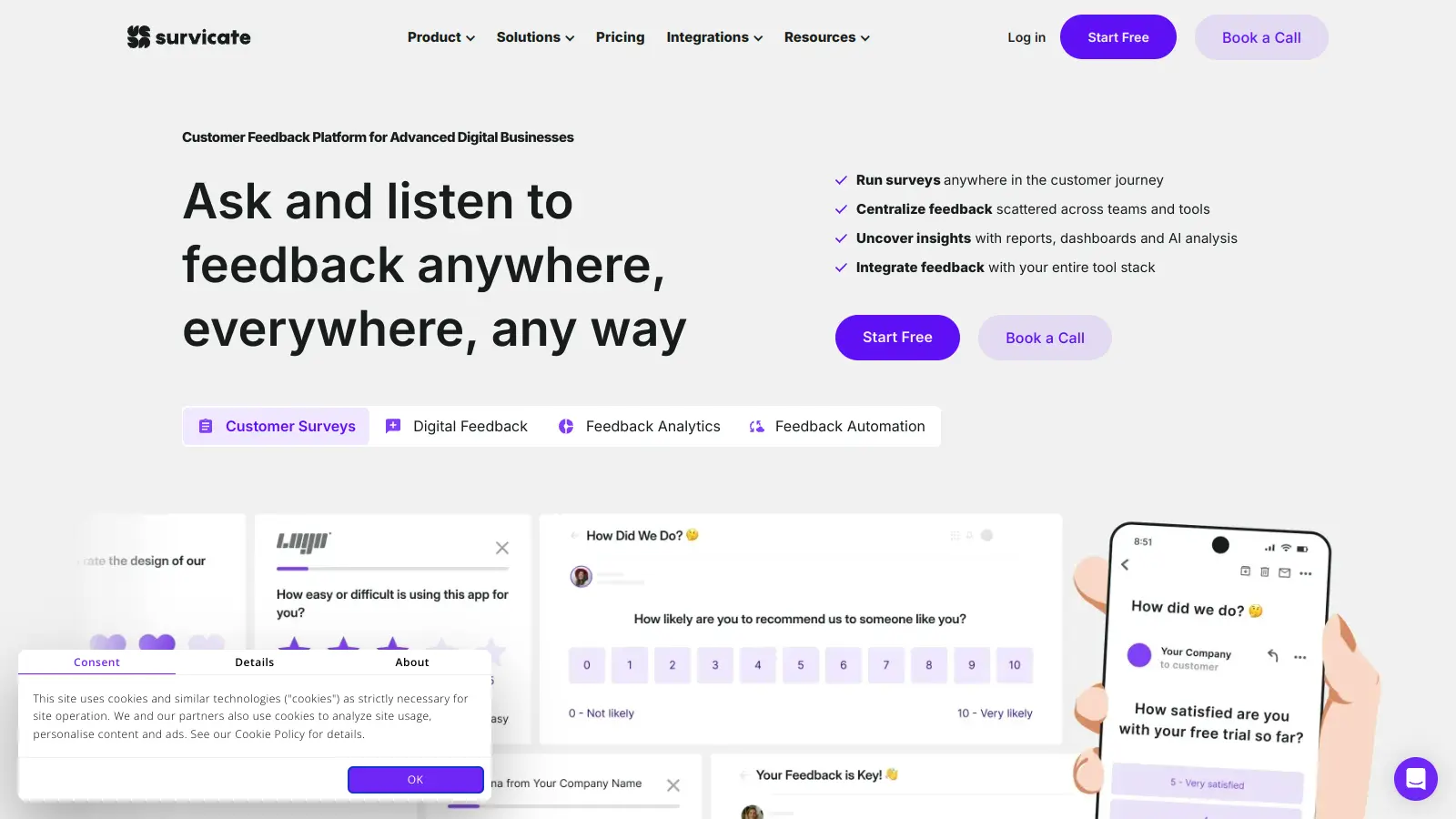
The platform allows organizations to deploy surveys across different channels, including websites, mobile apps, and email, enabling contextual data collection. Survicate is commonly categorized under customer feedback tools, survey software, and user research platforms.
Unlike traditional survey tools that rely heavily on standalone questionnaires, Survicate focuses on embedding surveys within user journeys. This approach aligns feedback collection with real-time interactions, which can influence the quality and relevance of responses.
Key Features Explained
Multi-Channel Survey Distribution
Survicate supports survey deployment across various environments. Surveys can be embedded directly on websites, displayed within mobile applications, or sent via email. This flexibility allows organizations to capture feedback at multiple stages of the customer lifecycle.
Targeted Survey Triggers
One notable feature is the ability to trigger surveys based on user behavior or predefined conditions. For example, surveys can appear after a user spends a certain amount of time on a page, completes a transaction, or exits a session. This targeting helps ensure that feedback is contextually relevant.
Question Types and Customization
The platform offers a range of question formats, including multiple-choice, open-ended, rating scales, and Net Promoter Score (NPS) surveys. Customization options allow users to adjust survey design to match branding or user interface requirements.
Integration Capabilities
Survicate integrates with various analytics and customer relationship management systems. These integrations allow collected feedback to be combined with behavioral data, enabling more comprehensive analysis.
Real-Time Reporting
Survey responses are collected and displayed in real time. Dashboards provide access to response summaries, trends, and individual answers, which can support ongoing monitoring and decision-making processes.
Data Export and Analysis
Users can export survey data for further analysis in external tools. This functionality supports organizations that rely on advanced analytics or need to combine survey results with other datasets.
Common Use Cases
Customer Satisfaction Measurement
Organizations often use Survicate to measure customer satisfaction through structured surveys such as CSAT (Customer Satisfaction Score) and NPS. These metrics help track changes in user sentiment over time.
Product Feedback Collection
Product teams use the platform to gather feedback on features, usability, and overall user experience. Surveys can be triggered after feature interactions to capture immediate impressions.
Website Experience Evaluation
Survicate is frequently used to understand how users perceive website usability, navigation, and content. Exit-intent surveys, for example, can provide insights into why users leave a site without completing desired actions.
Market Research
Although not a full-scale market research tool, Survicate can support smaller-scale research efforts by collecting targeted feedback from specific user segments.
Customer Journey Analysis
By placing surveys at different points in the user journey, organizations can identify friction points and areas where users encounter difficulties or confusion.
Potential Advantages
Contextual Data Collection
One of the primary strengths of Survicate is its ability to collect feedback in context. By aligning surveys with user actions, the platform increases the likelihood of receiving relevant and timely responses.
Ease of Deployment
Surveys can be implemented without extensive technical knowledge, particularly for web-based deployments. This accessibility allows non-technical teams to manage feedback collection independently.
Flexible Survey Design
The range of question types and customization options supports diverse use cases, from simple satisfaction surveys to more detailed feedback forms.
Integration Ecosystem
The ability to connect with other tools enhances the value of collected data. Integrations can help create a unified view of user behavior and sentiment.
Real-Time Insights
Immediate access to survey results allows organizations to respond quickly to emerging issues or trends.
Limitations & Considerations
Response Bias
As with most survey tools, responses may be influenced by self-selection bias. Users who choose to respond may not represent the broader audience, which can affect the reliability of insights.
Limited Depth for Complex Research
Survicate is designed for quick, contextual feedback rather than in-depth research. Organizations conducting extensive qualitative studies may require additional tools.
Dependency on User Interaction
The effectiveness of surveys depends on user engagement. Poorly timed or overly frequent surveys may lead to lower response rates or user frustration.
Integration Complexity
While integrations are available, configuring them effectively may require technical expertise, particularly when combining multiple data sources.
Data Interpretation Challenges
Collecting feedback is only one part of the process. Interpreting results accurately requires analytical skills and an understanding of survey design principles.
Who Should Consider Survicate
Survicate may be suitable for:
-
Product teams seeking ongoing user feedback
-
Customer experience professionals monitoring satisfaction metrics
-
Digital marketers analyzing user engagement and behavior
-
SaaS companies aiming to improve onboarding and retention
-
Website owners interested in usability insights
Organizations that prioritize continuous feedback collection and iterative improvements may find this type of tool aligned with their processes.
Who May Want to Avoid It
Survicate may be less suitable for:
-
Researchers requiring in-depth qualitative interviews or ethnographic studies
-
Organizations with limited capacity to analyze survey data
-
Teams seeking highly advanced statistical analysis within a single platform
-
Environments where user interruptions must be minimized at all costs
In such cases, alternative methods or tools may provide better alignment with research objectives.
Comparison With Similar Tools
Survicate vs Traditional Survey Platforms
Traditional survey tools often focus on standalone questionnaires distributed via email or links. Survicate, by contrast, emphasizes in-context feedback collection, which can improve response relevance but may limit survey length.
Survicate vs User Analytics Tools
Analytics platforms track user behavior but do not typically capture subjective feedback. Survicate complements these tools by adding qualitative insights, though it does not replace behavioral analytics.
Survicate vs Comprehensive Research Suites
Full research platforms may include advanced features such as usability testing, session recordings, and participant recruitment. Survicate focuses more narrowly on surveys, making it simpler but less comprehensive.
Survicate vs Competing Feedback Tools
Other feedback tools may offer similar functionality, including NPS surveys and website widgets. Differences often lie in integration options, user interface design, and customization capabilities rather than core features.
Final Educational Summary
Survicate represents a category of tools designed to collect structured feedback within digital environments. Its emphasis on contextual surveys reflects a broader shift toward integrating qualitative insights directly into user experiences.
While the platform provides practical mechanisms for gathering customer feedback, its effectiveness depends on thoughtful implementation, appropriate survey design, and careful data interpretation. It is not a standalone solution for all research needs but can serve as a component within a broader feedback and analytics strategy.
Understanding tools like Survicate requires recognizing both their capabilities and their limitations. As organizations continue to seek deeper insights into user behavior, survey platforms will likely remain a key part of the data collection ecosystem.
