
Introduction
The rapid expansion of artificial intelligence and machine learning technologies has created a growing demand for high-performance computing resources. Modern AI models, particularly deep learning systems used in areas such as natural language processing, image recognition, and generative AI, often require powerful graphics processing units (GPUs) capable of performing thousands of parallel calculations simultaneously.
For many developers, researchers, and small organizations, maintaining dedicated GPU hardware locally can be difficult. High-end GPUs are expensive, infrastructure requirements can be complex, and hardware may become outdated quickly as computing demands increase. These challenges have led to the rise of a specialized category of services known as GPU cloud platforms.
GPU cloud platforms allow users to access remote GPU infrastructure through virtual environments. Instead of purchasing and maintaining physical machines, users deploy workloads on remote servers configured for compute-intensive tasks. These services are particularly relevant for machine learning training, AI inference workloads, simulation experiments, and media rendering.
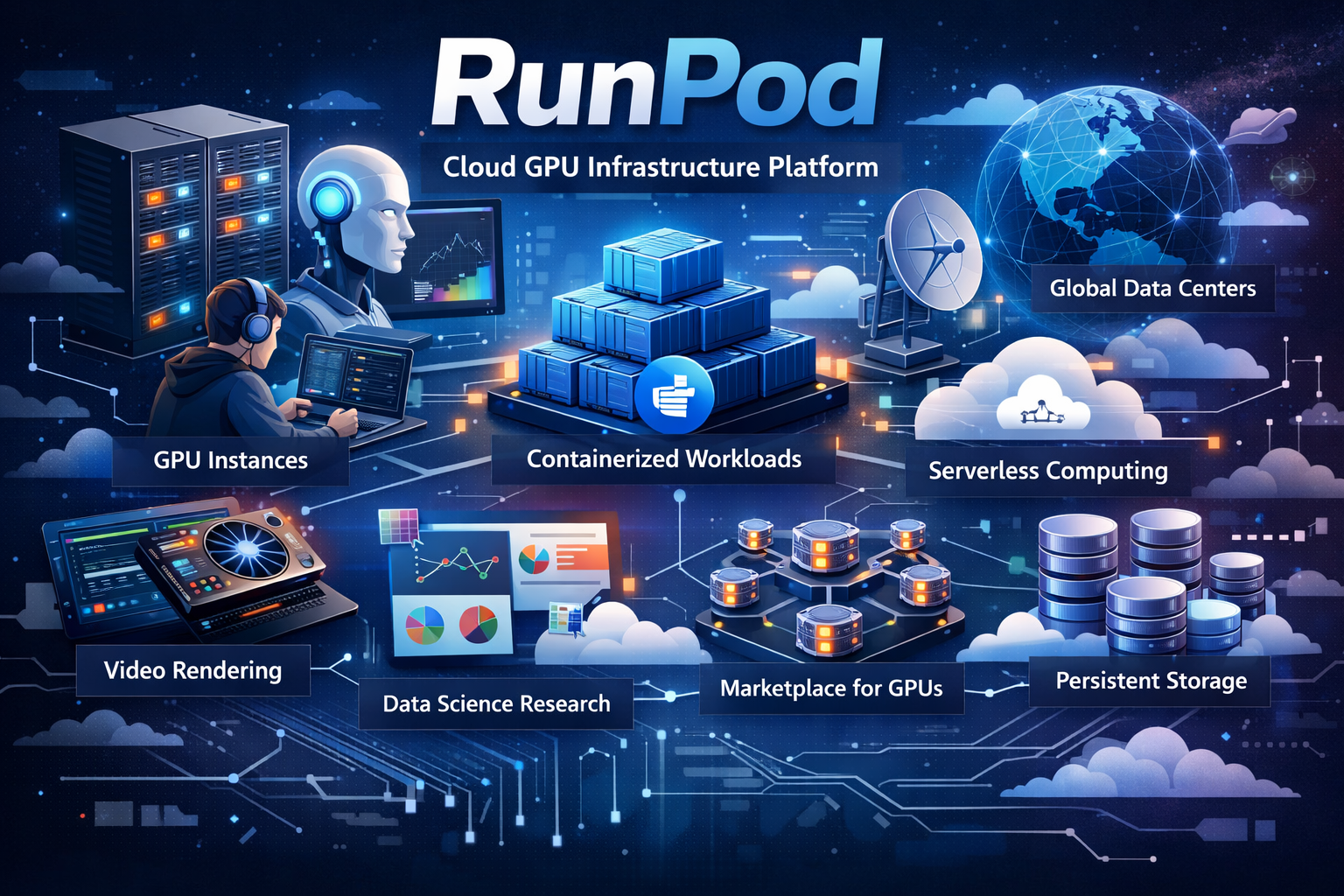
Within this infrastructure category, RunPod is designed to provide on-demand GPU computing environments. The platform focuses on enabling developers and researchers to launch remote GPU systems capable of handling complex computational tasks. Understanding how RunPod operates requires examining its architecture, features, and typical use cases within the broader AI infrastructure ecosystem.
What Is RunPod?
RunPod is a cloud computing platform that provides remote access to GPU-powered servers. The platform enables users to deploy computing environments equipped with specialized hardware designed for tasks that require high levels of parallel processing.
Unlike traditional cloud platforms that offer a broad range of services, RunPod primarily focuses on GPU-accelerated workloads. These workloads typically involve applications that benefit from massive parallel processing, such as neural network training, scientific simulations, data analysis pipelines, and graphics rendering.
The platform works by connecting users to distributed GPU infrastructure hosted across different data centers and hardware providers. Through virtualization and container technologies, developers can launch isolated computing environments configured with specific GPU models, memory allocations, and software frameworks.
In practical terms, RunPod functions as an AI infrastructure service that allows individuals and organizations to access high-performance hardware remotely. This infrastructure model enables users to scale computational resources depending on the requirements of their projects.
The system typically supports workflows that include:
-
Training deep learning models
-
Running inference for AI applications
-
Processing large datasets
-
Executing GPU-accelerated scientific simulations
-
Performing 3D rendering and visual computing tasks
By providing access to remote GPU resources, RunPod reduces the need for users to manage physical hardware directly.
Key Features Explained
GPU Instance Deployment
One of the central capabilities of RunPod is the deployment of GPU-powered compute instances. These instances function as virtual machines equipped with specialized hardware designed for parallel computation.
Users can choose from various GPU configurations depending on their computational requirements. For example, training large neural networks may require high-memory GPUs, while smaller inference tasks may function effectively with lower-capacity hardware.
Each instance operates as an isolated environment where developers can run machine learning frameworks, data processing tools, or custom software applications.
Container-Based Development Environments
RunPod supports containerized development environments. Containers package software applications together with their dependencies, ensuring that code runs consistently across different computing systems.
This feature is particularly useful in machine learning development because AI frameworks often rely on specific versions of drivers, libraries, and runtime environments. Containerization allows developers to reproduce the same environment across multiple computing sessions.
Containerized environments also simplify collaboration, as teams can share standardized configurations for experimentation or production workloads.
Serverless GPU Workloads
Another component of the RunPod architecture involves serverless GPU execution. In this model, computing resources are allocated only when code is executed. Once the task is completed, the infrastructure is released automatically.
This approach can be useful for workloads that run intermittently rather than continuously. AI inference tasks, batch data processing jobs, or scheduled computations may benefit from this architecture because resources are used only when necessary.
Serverless execution also reduces the need for maintaining persistent servers for short-lived tasks.
Distributed GPU Infrastructure
RunPod uses a distributed infrastructure model that aggregates GPU hardware from multiple providers. Instead of relying exclusively on a single centralized data center network, the platform connects computing resources from various host environments.
This distributed model expands the potential availability of GPUs, which can be important in situations where demand for AI infrastructure exceeds supply in traditional cloud environments.
It also introduces a marketplace-like structure in which different hardware configurations may be accessible across the network.
Persistent Storage Capabilities
For many computational workflows, storage plays an important role alongside compute resources. RunPod allows users to attach persistent storage volumes to their compute environments.
Persistent storage enables datasets, trained models, configuration files, and experiment outputs to remain available between sessions. This capability is particularly useful for long-term research projects or machine learning pipelines that involve multiple training iterations.
Development Templates and Environment Setup
Launching a new computing environment can involve several configuration steps, such as installing frameworks, drivers, and development libraries. RunPod provides templates designed to streamline the setup process.
Templates may include preconfigured environments for common AI frameworks or development stacks. These templates allow users to begin computational tasks more quickly while still maintaining flexibility for custom configurations.
Common Use Cases
Machine Learning Model Training
Training machine learning models often requires substantial computational power. Neural networks used for computer vision, speech recognition, and natural language processing may involve millions or billions of parameters.
GPU acceleration significantly speeds up training processes compared to traditional CPU-based computing. RunPod provides infrastructure capable of supporting these training workloads by offering GPU-equipped virtual environments.
Researchers and engineers can deploy training pipelines using common machine learning frameworks within these environments.
Artificial Intelligence Inference Systems
After a machine learning model has been trained, it can be used to generate predictions or outputs. This process is known as inference. Inference systems are commonly used in applications such as recommendation engines, chatbots, image classification systems, and voice assistants.
GPU-accelerated infrastructure can process inference requests more efficiently for large or complex models. Platforms like RunPod allow developers to run inference workloads remotely rather than relying on local hardware.
Data Science and Large-Scale Data Processing
Data scientists frequently work with large datasets that require extensive computational resources for analysis and transformation. GPU computing can accelerate certain types of data processing, particularly those involving matrix operations or machine learning pipelines.
Remote GPU infrastructure can support large-scale data analysis tasks without requiring local computing clusters.
3D Rendering and Visual Effects Production
Graphics processing units are widely used in visual computing tasks such as 3D modeling, animation rendering, and video processing. Rendering complex scenes often involves significant computational demands.
Cloud-based GPU infrastructure enables rendering workloads to run remotely, which can distribute tasks across multiple machines.
Scientific Research and Simulation
Certain research fields rely on simulation models that require high-performance computing. Physics simulations, molecular modeling, and climate analysis often involve computationally intensive calculations.
GPU-accelerated environments can speed up these simulations by processing multiple calculations in parallel.
Potential Advantages
Access to High-Performance Hardware
One advantage of GPU cloud platforms is the ability to use specialized hardware without owning it. High-performance GPUs used for deep learning are expensive and may require specific infrastructure for cooling and power management.
Remote access allows users to run workloads on these systems without maintaining the hardware themselves.
Flexible Resource Allocation
Computational needs can vary significantly depending on the stage of a project. Some tasks require significant processing power for short periods, while others involve smaller workloads.
GPU cloud platforms allow users to allocate computing resources dynamically, adjusting capacity depending on project requirements.
Reduced Infrastructure Management
Maintaining local computing clusters involves hardware maintenance, system administration, and network configuration. Cloud-based infrastructure shifts these responsibilities to the platform provider.
This allows developers and researchers to focus on software development, experimentation, or data analysis rather than hardware management.
Accessibility for Smaller Teams
Historically, large GPU clusters were mainly accessible to large technology companies or well-funded research institutions. Cloud infrastructure platforms have expanded access to high-performance computing for independent developers, startups, and smaller research teams.
This increased accessibility has contributed to rapid growth in machine learning experimentation and AI development.
Limitations & Considerations
Variable Hardware Availability
GPU resources are shared among many users. During periods of high demand, certain hardware configurations may be limited or temporarily unavailable.
Users may need to adjust workflows depending on available infrastructure.
Infrastructure Learning Curve
Although cloud computing reduces the need for hardware management, users still need to understand various technical concepts such as containerization, virtual machines, networking, and storage configuration.
Developers who are new to cloud infrastructure may require time to become familiar with these systems.
Cost Management
While cloud infrastructure eliminates large upfront hardware investments, long-running workloads can generate ongoing operational costs. Projects involving continuous GPU usage may accumulate significant computing expenses.
Careful resource management and workload optimization are often necessary.
Data Transfer Challenges
Large datasets may need to be transferred between local systems and remote infrastructure environments. Depending on dataset size and network bandwidth, this process can take time and may influence workflow efficiency.
Security Considerations
Organizations handling sensitive information must evaluate how data is stored and processed within remote infrastructure environments. Proper configuration and security practices are important for maintaining data protection.
Who Should Consider RunPod
RunPod may be suitable for individuals and organizations involved in computationally intensive work. Examples include:
Machine learning engineers training neural networks
AI researchers conducting large-scale experiments
Data scientists working with large datasets
Independent developers building AI-driven applications
Media production teams performing GPU rendering
Technology startups developing artificial intelligence systems
These users often require scalable GPU infrastructure to support experimentation or production workloads.
Who May Want to Avoid It
Not all projects require GPU infrastructure. Some users may find platforms like RunPod unnecessary.
Individuals performing lightweight programming tasks, simple data analysis, or standard web development typically do not require GPU-accelerated computing environments.
Organizations that already maintain extensive internal GPU clusters may also prefer managing their own infrastructure.
Users unfamiliar with cloud-based computing environments may initially find such platforms complex without prior technical experience.
Comparison With Similar Tools
RunPod exists within a broader ecosystem of GPU cloud infrastructure services. Several other platforms offer comparable computing resources, although their architectures and service models vary.
For example, Amazon Web Services provides GPU-enabled instances as part of its extensive cloud platform. These instances integrate with a wide range of enterprise infrastructure services.
Similarly, Google Cloud offers GPU-accelerated virtual machines optimized for machine learning workloads.
Another major infrastructure provider is Microsoft Azure, which also supports GPU computing environments within its cloud ecosystem.
The primary difference between these platforms often lies in their design focus. Large cloud providers offer comprehensive enterprise infrastructure ecosystems, while specialized platforms like RunPod focus primarily on GPU-based computing environments.
Users evaluating different platforms typically consider factors such as hardware availability, infrastructure design, integration capabilities, and pricing models.
Final Educational Summary
RunPod represents a specialized form of cloud computing infrastructure designed to support GPU-accelerated workloads. By enabling remote access to powerful computing hardware, the platform allows developers, researchers, and organizations to run computationally intensive applications without maintaining local GPU clusters.
Its architecture incorporates several key components commonly used in modern AI infrastructure, including containerized environments, distributed hardware networks, and scalable compute instances. These capabilities support a variety of workloads ranging from machine learning model training to visual rendering and scientific simulation.
At the same time, adopting remote GPU infrastructure involves considerations related to cost management, technical complexity, and data handling. Understanding these factors can help users determine whether such platforms align with their computing requirements.
As artificial intelligence and data-driven technologies continue to evolve, GPU cloud platforms are likely to remain an important part of the infrastructure supporting large-scale computational research and development.
Disclosure: This article is for educational and informational purposes only. Some links on this website may be affiliate links, but this does not influence our editorial content or evaluations.
